Category Archives: Posts

Teju Cole, Open City Chapter 10 – Adrian Garcia 

“It was the seventh day of the rain, which had been nagging, trickling, falling without biblical grandeur. But its longevity reminded me of the only other rain I could recall that had lasted for days… I was nine at the time, so it was the year before I was sent away to boarding school” (Cole 117-118).

These quote from the book lingers with me because it encapsulates the peculiar way in which Julius makes connections. At the beginning of chapter ten, Julius wakes up from a disconcerting dream and fails to recognize the time, the country, and the place he is in. Little by little, he remembers that he is staying in a rented apartment in Brussels, Belgium. Then, after a dreamless sleep, he mentions that there has been a ceaseless rain for the last seven days. In connection to the never-ending rain, he recalls a particular day during his childhood when he, succumbed to temptation, drank a bottle of Coke without the permission of his parents. This made me ponder about Julius’ intention when he scrutinizes specific components of his surroundings, like the rain. In other words, what is the importance of rain? What does it symbolize?

Another one of Julius’ distinctive connections is seen in chapter 2 when he alludes to Obatala, the Yoruba God responsible for the formation of humans from clay, after his encounter with the cripple and the two blind men on the 1 train station. I noticed that these connections made by Julius, in a way, are a great way for Cole to further describe certain characters that have yet to appear in the story and to insert similar ideas into the story.
Open City- Chapter 12

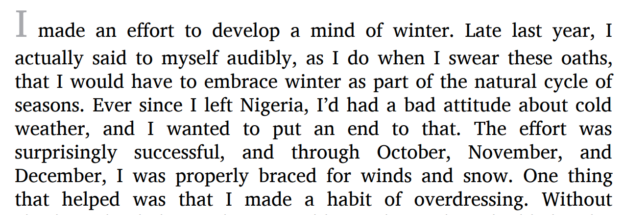
The opening of Chapter 12 showed one of the many things that others have had to adjust to after moving to a new place. The idea of adjusting to the cold, wintery weather in a way can also allude to Julius trying to make sense out of everything after moving away from Nigeria. During winter comes harsh snows and difficult weather and this is what Julius chooses to focus on which he tries to get used to by wearing more layers and being better prepared. Although I am not a fan of the winter, being in New York City during these times is quite enjoyable as many people are hanging up decorations, lights, and spending time with family due to the upcoming holidays. I found it interesting that the narrator did not focus much on this but rather had Julius adjust to the cold weather instead. I find that in this way, we can see even more as to how Julius has this disconnect with his surroundings as he tends to simple focus on what is on the surface level.

“Open City” by Teju Cole

“…by the time I came to the United States, three years later, I had no serious intention of writing to him, or anyone else. The promise to write had simply been a gesture of respect, an acknowledgement of the fact that once, when we were in our early teens, we’d been close, and even for a brief moment best friends,” (Cole 143).

While some may interpret this scene as insensitive, I found this to be very relatable on the human level. After we graduate from middle school or high school we promise to stay in touch with classmates and friends but tend to move on or forget to contact them. There are always some instances where people reconcile with others in the future and then promise to keep in contact but this usually falls short. To me this illustrates the self-isolation of the human and how even though we are social creatures, we still isolate ourselves for some reason which fascinates me. I also enjoyed this scene as it helps to humanize the character to a relatable level as we have had these things happen to us where we meet an old acquaintance, possibly forget their name, promise to keep in touch, but end up forgetting.

Open City(Chapters 10-16) – Zachary Rosman

(Cole 174)

These last few lines in Chapter 16 of “Open City” by Teju Cole spoke to me on a personal level. Having experienced extreme bouts of trauma, which bordered on mental breaks, I empathize with Julius’s feelings. These experiences make you think about your mortality. In Julius’s case, he sees his reflection and comments on life and death, a vivid image. He further implies that there are two versions of yourself when you are alive, the original – how you perceive yourself – and the reflection – how other people see you. When you are dead, however, the only thing that still exists is your reflection which is how others perceive you. Such a life and death reflection demonstrates how bad Julius’s trauma is and how messed up Julius’s mental state is. When I experienced what Julius experienced a few years ago, my anxiety trauma came to a head, I had a psychotic break, and I felt my sanity melt away. It was a terrifying experience. Overall, Julius having a similar reaction to trauma and anxiety helps assure me that these feelings that I had back in the day, even though they were very uncomfortable, are actually perfectly normal.
-Zachary Rosman

Teju Cole, Open City Chapter 12 Hannah Khanshali

This quote from chapter 12 stuck with me greatly due to the manner in which Julius references the past. Open City switches back and forth between time periods, with Julius telling stories and interactions with people who would not be alive today. This sentence summarizes and clarifies the way the past is portrayed in Open City. Life is experienced in continuity, we do not recognize its discontinuity until it is labeled as the past. Open City is told by Julius, our unreliable narrator, in a continuous manner, with breaks and new sections in the text when the time period switches. This discontinuity in the text is only noticed when it has become the past, or a different time period. This style greatly interests me as it also helped me understand the meaning behind the structure. It is very open, flowing, just as how life and New York is.

Julius mentions how the past is a vast open space, expanses of nothing. I believe this is especially true when trauma causes a person to block out certain memories or events of their past that caused much distress. This is true for Julius, as he admits this in this passage: “Nigeria was like that for me: mostly forgotten, except for a few things that I remembered with an outside intensity” (p141). Julius has forgotten much of his past in Nigeria. This is further emphasis on his disconnection and provides insight on relationship with Nigeria.

-Hannah Khanshali

Open City (Chapters 10-16) – Janla Camara

From the first paragraph alone, you can tell that Julius is longing for the desire of a “home” or rather, to be home but it is transparent that he does not know what that feels like. He wakes up from a dream of him and his sister running in a marathon in Lagos, yet he has no sister, and though he does not know where he is when he wakes up it is not Lagos. At the beginning of the story, we had a sense that Julius wanted to be separated from his origins and his family, but it seems here that all he wants now is just that: a family and a place to call home, but first, he has to break out of this bubble of forced loneliness.

Assimilation, Not Inclusion

“Our Society has made itself open for such people, but when they come in, all you hear is complaints. Why would you want to move somewhere only to prove how different you are? And why would a society like that want to welcome you?”

(Cole, p.129)

In this section of the book, Julius met up with his friend Dr.Maillotte. He brought up his friend Farouq’s difficulty of adjusting to Belgium as an Arab. Dr.Mailotte dismissed his friend’s difficulty and viewed his friend as a complainer who was not appreciating the freedoms of his new country. From her speech, we can tell that Dr.Mailotte was not a person who welcomed diversity and inclusion but one who believed that people should assimilate to the culture of a country. I found it interesting and almost funny that she mentioned how she also had difficulty moving from Belgium to the United States. Like Fiona McAllister in Disgrace, she did not recognize her white privilege. Dr. Mailotte takes the ignorance one step further, however, by believing that immigrants have no “excuses” when she was able to successfully adjust.

Through subtle hints from Julius’ train of thought, we can also make a lot of inferences about Julius’ feelings and subconscious thinking. For instance, Julius might have asked Dr.Maillote about his friend Farouq because he resonated with his friend’s difficulty in finding his identity in a new country. Hence, Julius was uncomfortable when Dr.Mailotte asked him if he was one of those complainers. He immediately jumped to a new topic in his subconscious, escaping the confrontation. He started a new train of thought, a new paragraph about how he wanted to ask Dr.Mailotte about her son. The reader never got to know his response. Thus, we can see that Julius is evading questions relating to his identity and belief in this development of the novel.

Open City, Chapters 10-16 Blog Post – Tevon Gayle

In the segment where Julius was talking about how he couldn’t remember his bank card code–though he had used it several times in his recent trip to Brussels– I thought of how peculiar he is as a character in this book. Like, “how could you forget the code you were dependent on for getting money the whole month prior?” But as he got into how the quick loss of memory was a product of “stage fright,” I remembered how that can happen in situations for us too like on a test or being in front of a large crowd of people. In this sense, as someone said in one of our class discussions, we can see aspects of his character we can relate with. His anxiety having forgotten the initial check book made him a little fearful of what the bank teller would do because of this. But in the end it didn’t seem to have been such a critical error for the bank teller. In page 147, we are told how the teller just shrugs off the situation. And so with this, we can see how Julius can relate to us who are outside the story, while still having traits that make him unique as a character.

Open City (12-16) – Melissa Builes

“Later that day, it snowed, the first snowfall I had witnessed in the season. A furious sense of imbalance came over me as I watched the flakes tumble down and disappear on contact with the ground.” (Cole, 151)

This line was a line a particularly liked because it made me realize how people all over the world have different views on things based on its accessibility. In places like Africa, South America, Asia…etc. you will never see snow, but in places like New York, this is a yearly occurrence. Oftentimes, New Yorkers dread the occurrence of snow because it’s messy and a hassle to deal with, not to mention it creates problems in many ways (parking, MTA, sidewalks). As a New Yorker I think of snow in one of two ways, I rather (1) I dread the idea or (2) don’t think about it at all. I would never think “oh it’s the first snow of this season” or I would never think about how the flakes tumbling down. We can see that Julius does do this, and this is most likely because he didn’t grow up with snow his whole life. Snow is something that I don’t appreciate because to me it’s normal, but ask someone from a different country that doesn’t grow up with it, and it’s a different story. I guess I just like the fact that this line makes me want to appreciate things in my day-to-day more. Thinking about it on a bigger scale, food and water are stuff I really take for granted, I have access to these things whenever I want. Unfortunately, not everyone can say the same. Thus, this line has really impacted me to look at small occurrences through a bigger picture and learn to appreciate the things we don’t normally think about.

“Open City” by Christian Velez (Part 2, Chapters 12-16)

“It must have been an unimaginably different place back then, I said. I did not tell him that my mother and oma had been there, too, as refugees near the end of the war and afterwards, and that I was myself, in this sense, also a Berliner. If we had talked more, I would have told him only that I was from Nigeria, from Lagos”. Page 139

This monologue from Julius is very interesting when looking at him in contrast to himself in the first half of the book. In chapters 1-11, Julius has expressed that he does not feel a sense of belonging in where he lives or with the people surrounding him. The tears from his childhood resulting from issues between his parents and the transitions from Nigeria to New York City left him stranded not knowing what to identify as. This resulted in him choosing to distance himself from people and developing the tendency to analyze and assess people from a distance rather than interact with them directly. In this scene, for one of the first times in the book, Julius makes an effort to interact with someone he doesn’t already know and attempt at forming a deeper connection with them due to interest he had. This contrasts the taxi scene toward the beginning of the book where Julius tried to dismantle the conversation between him and the taxi driver whom he shared similarities with. Additionally, here Julius finally finds a sense of belonging identifying himself as a Berliner, which was something he couldn’t do earlier in the book.

“Open City” (Ch 5 – 9): Lamyad Reham

(Cole, Pg. 78)

On his flight to Brussels, Julius meets a fellow passenger, Dr. Mailotte. The author’s heavy usage of imagery is a very important tool here as it exemplifies Julius’s tendency to avoid intimacy in favor of highlighting the details of the world around him perfectly. Julius over describes this stranger (down to irrelevant details like the type of earrings she is wearing) in order to drown himself out, leaving little room for the reader to engage with him as a person. Although this is hardly the first time that Julius has made such an effort to stay anonymous, this specific passage is interesting as we see his desperation. Having nothing but the person next to him to describe, he overcompensates by going down to the most minute detail. By painting such a vivid and clear image of the woman sitting next to him (even including the colors and patterns on her clothes), he tries to distract the reader from himself.

Open City (Chapters 5-9)

Scene at the restaurant with Farouq, Khalil, and Julius when they begin discussing portrayal in the middle east

Julius’s thoughts where he pretended to an anger that he didn’t have because he felt that the “game” required him to pretend to be an outraged American resonated with me most, not with being the outraged American, but because like him, I wasn’t sure how to feel about the scene. I wasn’t sure whether to be shocked and overly critical of their support of terrorist organizations, or to approach it as a view that although untactful in its expression and unwise in its support, was still comprehensible. In that passage, Cole uses abrupt and terse sentences which serves to reinforce the sense of a volatile mood between the characters as they go back and forth with one another leading to shocking statements being made. The setting is also another aspect of the writing that reinforces or is meant to be seen as even having led to the angry mood in the scene. The loud restaurant scene with alcohol, cigarettes, and loud speech played a significant role in the mood and can be used to explain why Julius seemed unwilling to probe into the deeper meaning and ideas behind their statements and why the two other men seemed unwilling to expand on their ideas.

Response to Mohammed’s Blog Post from Open City (CHAPTERS 5-9)

I think that there is some deeper meaning as to why he is able to have a close connection with the older folks in his life. This relates to the confusing stage of being a young adult where you are expected to be a grownup, but you are still treated like a child because people don’t think that you are responsible enough. The older people in life treat him a way where he feels like they are equals and that difference in their ages is irrelevant in their deep conversations.

Open City (CHAPTERS 5-9)

“I have always had a problem with the shoeshine business, and even on the rare occasion when I wished to have my scuffed shoes cleaned, some egalitarian spirit kept me from doing so; it felt ridiculous to mount the elevated chairs in the shops and have someone kneel before me. It wasn’t, as I often said to myself, the kind of relationship I wanted to have with another person.”

This idea of having someone kneel before you gives me royalty vibes because it reminds me of the kind of relationship that Nigeria had with America during times of war. Nigeria expected the United States to be their savior and help them but when they never did it was confusing because they thought they would have their back. Nigeria thought that they could depend on the US because they have the resources and the power to do so. This act of kneeling does feel kind of weird because you feel like you are someone who is in power and a sense of entitlement because you on a pedestal. The US was put on a pedestal because of their successful succession from British rule, so Nigerians looked up to them since they were in the same boat. Nigeria thought that since they were in the same boat at some point they could get help from from.

Open City’s Interruptions

As we’ve discussed in class, Open City narrative tone is quite unique, with the plot often seeming pointless which allows the storyline to feel almost like a journal from Julius’s daily happenings. I’ve noticed that Cole uses various different methods to obtain this feel to the narrative. For example, when Pierre is telling Julius his life story in chapter 5, Cole writes the following:

“Pierre paused. Another customer, a balding businessman wearing a too-tight suit, came into the shop and, seemingly out of nowhere, a sullen young man appeared to clean his shoes. The businessman labored for breath. Pierre glanced over at his co-worked. He called out, You need to call Rahul about the schedule for next week. I’m off tomorrow, and I can’t do it. Then he rubbed my shoes down with a dry cloth and picked up a foot-long brush.”

Here, we see an almost meaningless interaction interrupting Pierre’s story. Novels are not real life, and there is no need for Cole to have created that interruption that served no purpose for the plot other than for the sake of invoking a certain feeling in the narrative. It almost makes Julius’s story feel like real life, how he journals his stories that contain real-life, pointless interruptions.

Open City (5-9)

In many instances now, when Julius is faced with a profound or traumatic moment, he abruptly disengages from the situation. While Julius portrays himself as an intellectual, he is actually afraid to cross a boundary or hold an opinion. In this conversation where Farouq is brimming with passion claiming Palestine “the central question of our time,” Julius’s thoughts are underwhelming. He lackadaisically distracts himself with a “meaningless visual”. The switch from the central question of our time to something inconsequential makes me feel less like we are seeing the random patterns of a stream of consciousness. Rather, Julius makes deliberate attempts to divert his attention from topics that have deep roots in things such as violence or trauma. Even in this trip to Belgium where he wants to find his Oma, his approach is extremely passive and he spends a majority of his time checking his email and engaging in frayed relationships. Going back to our conversations about Julius’s mental state, I don’t think we need to classify him as unwell based on his haphazard or jumbled stream of consciousness. His way of thinking feels more a reflection of the disconnect and isolation that permeates into all of his relationships.

Open City

“We reprised the old relationship[…]An hour went by quickly[…]I promised to return soon”

This set of lines stood out to me because it shows it was the first time that he’d interacted with another character on a personal level and revealed warmth towards others. Being so analytical and somewhat egocentric, which I believe the author attempts to portray through the steady stream of consciousness, and very quick to diverge his thoughts towards his surroundings rather than his interactions, it was surprising first coming across the warmth with which he described Professor Saito and their relationship.

“Open City” by Teju Cole

“And so when I began to go on evening walks last fall, I found Morningside Heights an easy place from which to set out into the city … These walks, a counterpoint to my busy days at the hospital, steadily lengthened, taking me farther and farther afield each time, so that I often found myself at quite a distance from home late at night…” (Page 1)

This particular passage stood out to me in a number of ways. Not only did it help to set up the following reading but also applied greatly to my real life. In the reading, the narrator talks about going on several wondering walks throughout the city in which he recalls things he sees or conversations he has. However, at the same time, he still feels a slight disconnection from his surroundings despite being so surrounded by it. There is somehow a dissociation between the people which I find to be intriguing and very true. I found this passage to be very relatable to me as at times, after school, I would just wander around the area and keep walking until I come to my senses as if I was on autopilot. Especially as a city filled with so many people yet feeling dissociated, this passage is very intriguing and relatable for me.

“Open City”- Teju Cole

I haven’t lived in New york City my whole life. But for the time that I have been here, I can attest to the loneliness an overwhelming population can bring. And that’s the same experience Julius has throughout almost every interaction. It begins with the standard experience of being on the street, seeing people, and being more isolated than you would be at home. It then extends to his interactions with a mentor. The mentor lectures to him and responds to his prompts. But it never gets personal. And the relationship almost has a professional quality to it. Exiting this interaction, he is faced with the NYC marathon and finds himself talking to a runner. Again, the runner has no one. Here is an individual who performed an incredible feat and was left alone. He had no family or friends. Julius begins to make comparisons between the marathon, his walks, and the subway. You can go at any pace, absorb any quantity of information, accomplish a lifetime’s worth of achievements, and still be left alone. There’s no one here for you. A city full of people whose existences are almost inconsequential to one and other.

“Open City” by Teju Cole – Adrian Garcia

I really enjoyed reading these chapters from Teju Cole’s “Open City” especially because it submerges us into Julius’ experiences and thoughts as he wanders aimlessly through New York City during the final year of his psychiatry fellowship. Cole achieves this effect by using sensory details as well placing us in Julius’ perspective. A central theme emphasized in these chapters is isolation and how people can become oblivious to the events happening around them. A particular quote that exemplifies this idea is, “Walking through busy parts of town meant I laid eyes on more people, hundreds more, thousands even, than I was accustomed to seeing in the course of a day, but the impress of these countless faces did nothing to assuage my feelings of isolation; if anything, it intensified them” (Cole 5). This quote shows that although Julius found himself in a vibrant environment as he went on his usual walks, he could not find the antidote to his loneliness. And although it may not seem like it, this is a mutual feeling among many New Yorkers. How many of us see each other for a few seconds and then suddenly disappear? Do we really sense a feeling of companionship?

Open City by Teju Cole, Ch 1-4 by Hannah Khanshali

Chapter 1 of Open City is such a striking introduction to the life of Julius and his interactions with New York City, the Upper West Side, and his own mind. I have selected two quotations from chapter 1 of Open City, both of which connect to form a similar message that intrigued me greatly.

The first quotation appears early on into our introduction of Julius on page 4, but establishes an important recurring theme of isolation. Julius encounters thousands of faces, that seemingly should create an atmosphere of unity and togetherness, but is instead profoundly isolating. This is a very relatable statement to New Yorkers; Julius is surrounded by people who are living their own alternate lives completely separate from his own. Walking alone in a crowd of people is a reminder of how you are alone in your own thoughts and experiences, in your own life that feels like an alternate reality. Julius, a psychiatry fellow, seems to psychoanalyze himself frequently in this introduction, showing signs of anxiety. Cole makes specific word choices in this statement, such as “impress of these countless faces” (5). The emotional mark of the many faceless individuals is a reminder that you are surrounded by strangers where you are unknowing of their lives and activities, creating feelings of isolation and anxiety.

The second quote from page 18 elaborates further upon this idea of isolation, but instead of it being another countless face, it is through an interaction with Julius’s neighbor Seth. Hearing of Carla’s death was a major shock to Julius, as he doesn’t even know of such a detrimental event in his neighbors life, whom he shares a wall with. The syntax in this quotation emphasizes the disconnect between their lives, the almost ignorance that you experience in New York, a place so busy it is isolating. Julius is so wrapt up in his own life, his own distress, he cannot even notice a shift of behavior in his closest neighbor. Julius is surrounded by people in an apartment building, his own home, but he is more isolated than ever, enclosed in his own life.

-Hannah Khanshali

Open City- Khushi Oza

I really enjoyed reading this as it was a very calm and interesting narrative so far. At first, I was confused due to the lack of plot and almost aimless wanderings but the simplicity in his writing truly paints a picture of how even despite being in one of the busiest cities in the world, it can still be so serene. The first person narrative in this writing also reminded me of the same feelings and thoughts I have while walking in the city and going home from a long day. Literally just looking at every little detail of what you pass by and allowing your mind to wander and retrieve old memories and form ideas with such fluidity and without disturbance.

This writing also reminded me very much of my father as he came to this country also while he was pursuing his residency in psychiatry and the stories he told me of him walking in Brooklyn at night and missing his home greatly reminded me of Julius in a way when it comes to this rift between culture back home and coming to this lively and different city. I admire how in some ways, we can all relate to this as going anywhere far from our home, or comfort zone, or familiarities can cause us to feel homesick by just wandering and observing new things in our trails. It is almost ironic that to be in a place full of new things, such as subways, city lights, cars, can remind us of the opposite and think of serenity at home.

“Open City” by Christian Velez (Part 1, Chapters 1-6)

“And how odd it was, hours later, to hear her strained voice, in counterpoint with the protestors down below. She had moved to San Francisco a few weeks before, and we had said we would make an effort to work things out at the distance, but we’d said the words without meaning to them” Page 21-22

Prior to this segment of the book, Julius was monologuing about a woman’s march that was happening (and could be heard) outside of his apartment with many young women chanting “Woman’s bodies, Women lives, we will not be terrorized” towards Amsterdam Avenue. This is interesting considering the connection Cole makes between the march and Julius’s relationship with Nadege in the following paragraph. Nadege and Julius were at one point lovers (supported by Nadege’s first introduction mentioning her as Julius’s girlfriend) and at some point, they tried transitioning into a long-distance relationship. However, it seems that didn’t work out as Julius states “We’d said those words without meaning to them”. Cole starting Julius’s monolog by mentioning the protestors and ending it by mentioning “words without meaning to them” could be referencing how some people attend protests but don’t attend it for the cause or don’t commit to periodically supporting the cause afterward due to not being passionate on the issue. This is similar to Julius and Nadege, demonstrating how a lack of commitment from both of them resulted in the downfall of their relationship.

On Teju Cole’s City (Part 1)

Cole p. 24

One of the things I really like about the first few chapters is how Cole plays with the idea of connection and solitude. Over the first few chapters, Cole reveals how Julius experiences the world around him, and the connections he makes with others. Despite living adjacent to his next-door neighbor, Seth, for years, he doesn’t learn about Seth’s wife’s death until years after the fact. At the same time, though, he manages to maintain a long-distance relationship with his girlfriend, Nadege. Through this juxtaposition, Cole demonstrates that distance is an illusion. Connection with others depends on something much more complex than distance. 

I think connection means sharing an understanding with someone else. To be able to understand even a bit about someone else means to be connected to them. Julius is able to connect with his oma while waiting for his parents to finish their mountain tour. Even though they don’t exchange a single word, they connect through their shared silence. Julius doesn’t connect with his neighbor because neither of them has been able to share something with each other. That said, even if you try to understand someone else, sometimes the connection just doesn’t click. Julius can’t understand the depression that V endures despite their therapy session. He fails to be impressed by jazz music, which his friend claims will change his worldview. 

There seems to be an unpredictable formula at work: an indescribable universal equation that determines whether someone is able to form a connection with someone else. It’s not as simple as talking with someone else. Connections can be formed in silence, and can fail to form even in conversation. There seems to be something extremely personal about connection, which is why Julius’ friend is able to enjoy jazz much more than Julius is able to. Cole doesn’t give us a direct answer but leaves us to ponder what it means to connect with someone else. On a personal level, we are left to think about what our connections to our friends and family are based on, and whether they’re strong or weak.

Open City (Chpt 1-4) Blog Post- Sajeda S.

I must mention that Upon first reading this novel, I was intrigued because it wasn’t like the typical novels I usually read on. While according to google this novel does fit the standard definition of “a modem form of literature that describes fictional characters and events usually in the form of a sequential story”, this novel, in particular, spoke out to me as a diary/conversational transcription style writing. Jumping from scene to scene it felt like Julius was just speaking out to us, the reader, about his days and thoughts throughout it.

Within this, I found it more intriguing that he would always have moments of self-awareness about himself in relation to others around him. The self-awareness was more of him pitying himself. We see in his interaction with the professor, he alluded to the audience that he had to pay the professor a visit because of the long timeout that he didn’t; he started to paint this image of pity for himself and his relationship with the professor but stating ” He must have seen something in me that made him think I was someone whom his rarefied subject …would not waste. I was a disappointment in this regard, but he was kindhearted…” (7) He later felt pity again when he meets the old man that ran the marathon and additionally when he saw Seth and heard about Carla’s dead or even when thinking about being an “overthinker” when it came to global warming. All these encounters took me by surprise because they contradicted a statement that he brought up earlier on how his walks in the city were “therapeutic.” All the times that he pities himself were during or shortly after his walks. The walks were essentially a way for him to think, relax, and wander off from his normal everyday life in the hospital. However, I think this contradiction that he plays out kind of emphasizes his subtle point of even if you are in a city you still alone motive. I just that leading idea was fascinating, especially as a native New Yorker.
